

How To Spot Fake Kurapia Being Sold
Like many game-changing products, Kurapia has started to attract imitations. One question we often receive is, “My local nursery is selling Lippia in flats. Is that the same as Kurapia?”
The answer is always the same: No, it isn’t.
Kurapia New White and Kurapia Pink are among the fastest-establishing groundcovers in the world. They’re quick to root, quick to fill in, and fast becoming the most sought-after lawn alternative on the market. But popularity has a downside. Like any in-demand product, Kurapia has attracted fakes, ripoffs, and illegal propagation. We spend a lot of time playing “whack-a-mole” with dishonest sellers, and it’s a problem we deal with continually.
The good news is that once you know how real Kurapia is grown and sold, identifying a fake becomes much easier. Here’s how to protect yourself.
How Is Real Kurapia Sold?
There are only a few ways authentic Kurapia ever reaches a customer. Knowing them makes counterfeits easy to identify.
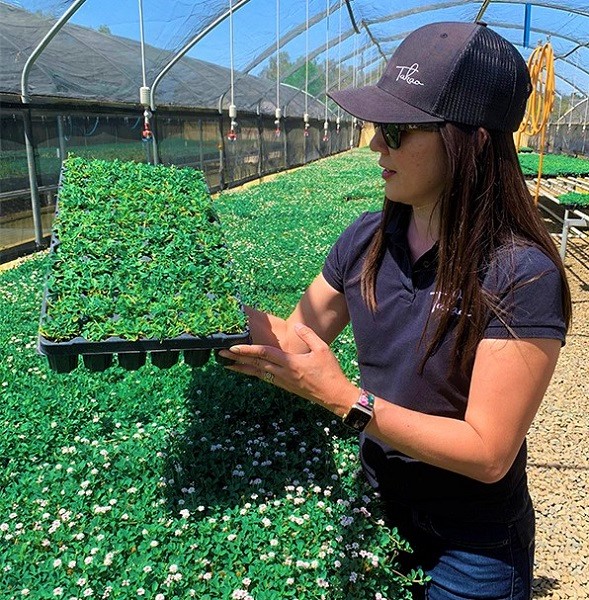
Real Kurapia is sold only as plugs. Kurapia New White (PP27036) and Kurapia Pink (PP29010) are available exclusively as plugs, 72 plugs per flat, grown by our contract grower in Fresno, California. The best way to get genuine Kurapia is to order directly from us.
Buy direct from the source. Kurapia is never sold through retail nurseries. If you see “Kurapia” on a garden center table, it isn’t ours. The surest way to get the real thing is to order directly from us, the sole producer.
We don’t sell other sizes or formats. No square “mud flats,” no six-packs, no gallons, no 3″ or 4″ pots. If someone is selling “Kurapia” in any of those forms, it isn’t ours.
Every plug is grown in a patented Ellepot. Each plug is held in a special fiber pouch that the roots grow through, a design engineered to protect the root mass and give each plant the strongest possible start.
Every plug arrives clean. Real Kurapia plugs come in a sterile, soilless mix that’s free of weeds, pests, and disease. Our product is grown in its own dedicated propagation environment specifically to guarantee the finest quality. This is one of the biggest differences between authentic Kurapia and the knockoffs, and it directly affects how your groundcover performs once it’s in the ground.
What Do Fake Kurapia Plants Look Like?
Counterfeit and imitation “Kurapia” generally falls into one of three categories.
Seed-Grown Lippia Nodiflora
Lippia nodiflora is an older name for Phyla nodiflora, the wild species Kurapia was bred from. Kurapia shares the species name, but it is not the same plant. It is a patented, sterile cultivar developed through years of breeding in Japan. Generic seed-grown Phyla dies back in winter, goes to seed, and spreads aggressively across your yard. It also lacks Kurapia’s deep roots and dark green color. Same species name, very different plant.
“Mud Flats”
These are groundcovers grown in soil inside a square plastic tray. The installer either rips the entire flat out and lays it across the ground, or breaks it into small chunks to plant. It’s a wasteful, low-quality method: the plants come with a tiny root mass, and tearing them apart kills most of what you paid for.
Illegally Propagated Plants
This is the sneakiest category. It may be an unauthorized copy of one of our patented varieties, an older variety sold under the Kurapia name, or a seed-grown Phyla that vaguely resembles the real thing. Kurapia is our trademark, so any plant sold as “Kurapia” without our authorization is not genuine, whatever it actually is. These plants are usually grown in field soil and rushed to sale, the opposite of the clean, controlled process behind real Kurapia.
How to Protect Yourself From Fake Kurapia
See “Kurapia” at a nursery? Contact us. We don’t stock retail nurseries, so if you spot it for sale on a shelf, let us know. We’ll help make sure people aren’t ripping off our customers.
A landscaper claims they can get Kurapia in flats? Be skeptical. Real Kurapia only comes as plugs. If it’s in a mud flat, a pot, or a six-pack, it’s a fake, no matter what they call it.
Know that Kurapia is not the same as generic Phyla or Lippia. Kurapia is a specific patented cultivar. Plants sold under the generic species name are not Kurapia, and buying them can leave you with a patchy, weedy yard.
When in doubt, ask us. We’re the sole producer of Kurapia, and we’ll confirm whether what you’re being offered is genuine.
Frequently Asked Questions About Fake Kurapia
Is Kurapia the same as Lippia or Phyla nodiflora?
No. Kurapia is a patented, sterile cultivar of Phyla nodiflora, bred for deeper roots, tighter and lower growth, a darker green color, and greater durability. Generic seed-grown Phyla or Lippia dies back in winter, goes to seed, and spreads aggressively. Kurapia stays uniform and does not produce viable seed.
Can I buy Kurapia at a nursery?
No. Kurapia is never sold through retail nurseries, so any “Kurapia” on a nursery shelf is not our product. Order directly from us to be sure you’re getting the real thing.
What size does real Kurapia come in?
Real Kurapia is sold only as plugs, 72 plugs per flat, each grown in a patented Ellepot fiber pouch. We do not sell Kurapia in mud flats, six-packs, gallons, or 3″ or 4″ pots.
How do I know I’m getting authentic Kurapia?
Order directly from us. Authentic plugs arrive in a clean, sterile, soilless mix free of weeds, pests, and disease. If you’re ever unsure, contact us and we’ll verify it for you.
Get the Real Thing
Genuine Kurapia is an investment in a beautiful, drought-tolerant, low-maintenance lawn alternative. Don’t let a counterfeit undermine it. When in doubt, order directly from us. A two-minute conversation can save you a full season of headache.
Thank You!