

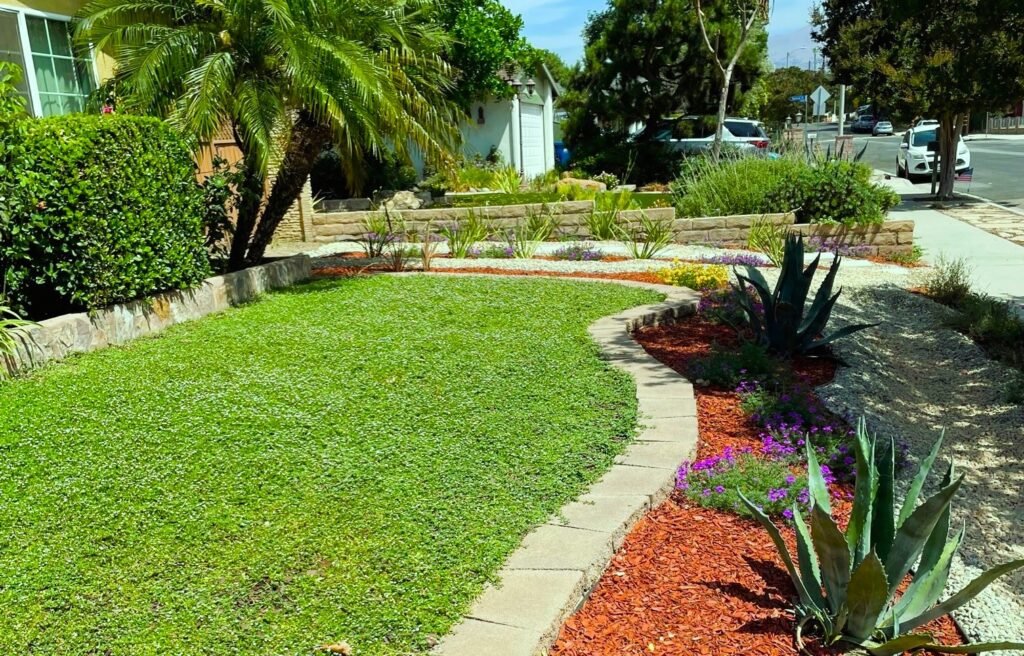
Why Kurapia Is The Best Drought Tolerant Groundcover
Most drought-tolerant groundcovers ask you to give something up. Some save water but look patchy. Some look great but can’t handle foot traffic. Some survive the summer and disappear in winter. Kurapia was bred so you don’t have to choose. After more than two decades working with drought-tolerant groundcovers, here’s why we believe Kurapia is the best one available.
What Makes Kurapia Different
Kurapia is a patented, sterile cultivar of Phyla nodiflora, developed through years of selective breeding in Japan. It shares a species name with wild Phyla, but it is a very different plant. Kurapia was selected for:
- Dark green leaves that read as a true lawn, not a weedy groundcover
- Low, horizontal growth that spreads across the surface to form a tight, uniform mat
- Vibrant flowers that drop off clean, with no seed heads and no mess
- Deep roots that reach far below the surface for water
- Sterility, so it does not set viable seed or spread into places you don’t want it
Kurapia is the top-selling 4″ groundcover in Japan, and in the United States Kurapia New White (PP27036) and Kurapia Pink (PP29010) are available only as plugs, grown in Ellepot fiber pouches in a clean, soilless mix by our contract grower in Fresno, California.
Roots That Go Down 10 Feet
Deep roots are the reason Kurapia handles drought so well, and it’s a claim we’ve tested ourselves. We grew Kurapia in 10-foot clear tubes, watered only from the bottom, so we could watch the roots grow. The roots reached the bottom of the tubes. Once established in the ground, those roots let Kurapia draw on soil moisture far below where a typical lawn’s roots stop.
About 60% Less Water Than a Traditional Lawn
Compared to the traditional California lawns it most often replaces, St. Augustine and dwarf tall fescue, an established Kurapia lawn typically uses about 60% less water. University research backs that up:
- UC Riverside researchers tested Kurapia at irrigation rates of just 30, 45, and 60 percent of reference evapotranspiration, and found how often it was watered mattered more than how much.
- In a UC Riverside drought study of 19 lawn species and cultivars, Kurapia was among the top performers, alongside kikuyugrass and buffalograss.
- At UC Davis, a lawn planted 100% in Kurapia on subsurface irrigation met California’s Model Water Efficient Landscape Ordinance (MWELO) water budget in its second year.
How often you water depends on your soil. Our established Kurapia lawns in South Pasadena are watered about once a month. A customer in Fallbrook found weekly watering kept their Kurapia spreading. Sandy soils drain faster and need more frequent watering than clay. New plantings are different: plugs need regular water until their roots are established. Our Support Guide has watering instructions for each soil type, and following it during establishment is the single biggest factor in a successful Kurapia lawn.
Built for Heat and Cold
Kurapia is suited to USDA Zones 7b and warmer, where it stays green year-round. A customer in Ojai reports their Kurapia comes through winter frost unharmed and handles summer heat of 109 to 115°F.
Low Maintenance, High Reward
Forget weekly mowing. In the UC Davis trial, the Kurapia lawn on subsurface irrigation was mowed fewer than three times a year. Kurapia doesn’t need fertilizer to thrive. The Kurapia lawns we maintain haven’t been fertilized in over a year. If you want a showier bloom for a special occasion, a light feeding a few weeks ahead will bring on more flowers, but it’s optional.
Good for People, Pets, and Pollinators
Kurapia holds up to everyday life. A customer in Los Angeles told us their Kurapia has held up to a new puppy, and they plan to extend it into the areas the dog had worn down. Its flowers support bees and other pollinators. And the species Kurapia comes from, Phyla nodiflora, is edible. It’s grown as a culinary herb and sold internationally as an herbal tea and supplement, which is reassuring for anyone with curious kids or pets.
Kurapia New White or Kurapia Pink?
Both varieties share the same water efficiency, durability, and deep roots. Kurapia New White has clean white blossoms for a classic, refined look. Kurapia Pink adds soft seasonal color.
Real Results
A landscape designer in Texas reported their Kurapia lawn filled in completely within three months. In Southern California, one project replaced 1,600 square feet of lawn with Kurapia and cut watering to five minutes, twice a week.
The Bottom Line
Kurapia gives you a dark green, durable lawn that uses a fraction of the water, rarely needs mowing, and doesn’t need fertilizer, backed by university research and years of real-world installs. If you’re replacing a lawn, it’s the best drought-tolerant groundcover you can plant.
Order Kurapia New White or Kurapia Pink directly from us, or contact us with any questions. Landscape professionals can apply for trade pricing.
Thank you for visiting Kurapia.com!